






Trapezoidal sheet garage: structure, insulation & insulated alternatives
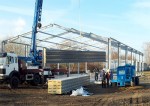
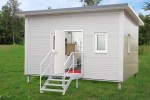
A trapezoidal sheet metal garage offers economical protection for vehicles, tools and equipment. The robust sheet steel construction impresses with its quick assembly, durability and low acquisition costs. Trapezoidal sheet metal garages can be realised as prefabricated garages or as self-build projects.
However, while trapezoidal sheet metal has proven properties as a building material, there is a serious problem: a lack of thermal insulation leads to condensation, temperature fluctuations and moisture damage. If you want a comfortable garage that can be used in the long term, you should opt for factory-insulated sandwich panels.
What is a trapezoidal sheet garage?
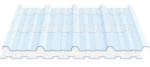
A garage with trapezoidal sheet metal is a closed building whose roof and walls are made of profiled sheet steel. The trapezoidal corrugations give the thin sheet metal (typically 0.5-0.75 mm) the necessary stability for the structure.
Trapezoidal sheet metal garages are mainly found in detached houses, commercial properties and farms. They provide sheltered space for vehicles and serve as a workshop, storage room or hobby room. Assembly is quicker than with brick garages and the galvanised, coated surface guarantees a service life of 25-35 years.
Typical designs:
- Single garage for 1 vehicle
- Double garage for 2 vehicles
- Large-capacity garage for vans, motorhomes or agricultural machinery
- Prefabricated garage (prefabricated) or self-build
The construction consists of a substructure (steel or timber frame), purlins for the roof and walls and the trapezoidal sheet metal cladding. A concrete foundation or floor slab forms the base.
Advantages: Economical, quick assembly, low maintenance, various sizes possible
Disadvantages: No thermal insulation, condensation, strong temperature fluctuations, no sound insulation
Construction of a garage with trapezoidal sheet metal
Trapezoidal sheet metal garage roof
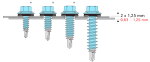
The garage roof is constructed in the same way as hall constructions. Trapezoidal sheet metal requires a minimum roof pitch of 5° (8.7 %), 7-10° is recommended for reliable water drainage. The sheets are laid across the roof pitch on purlins and fastened exclusively in the raised beads using self-drilling screws with EPDM seals.
Construction details:
- Purlin spacing depending on profile height (typically 1.5-2.5 m)
- Consider snow load of the region
- Overlap of the sheets: at least half a profile wave
- Eaves sheet and verge sheet as a finish
Trapezoidal sheet metal is available in various RAL colours. Standard colours such as RAL 7016 (anthracite grey), RAL 9002 (grey white) or RAL 3009 (oxide red) are suitable for most buildings.
Walls and authorisation
The walls of a trapezoidal sheet garage are constructed in a similar way to the roof. Vertically or horizontally laid trapezoidal sheets are screwed onto a substructure. A garage door (up-and-over door, sectional door or roller door) forms the entrance.
Authorisation: The authorisation requirement for garages varies depending on the federal state. In principle, the following applies:
Permit-free often up to: 30-50 m³ enclosed space (depending on the federal state), distance from the property boundary maintained, height limit observed
Requires authorisation mostly for: Larger garages, border development, certain building areas
Building regulations must also be observed for garages that do not require authorisation. Check the requirements with your building authority before starting construction.
Why insulate garages?
Uninsulated trapezoidal sheet metal garages are freezing cold in winter and unbearably hot in summer. But temperature is not the only problem - condensation is the biggest challenge with sheet metal garages.
Condensation: In winter, humidity condenses on the cold inside of the trapezoidal sheet metal roof and walls. Dripping condensation damages vehicles, tools and stored items. Rust on vehicles, mouldy cardboard boxes and corroded tools are the result.
Temperature fluctuations: Without insulation, the garage heats up to over 40°C in summer. Plastic parts on the vehicle become brittle and paintwork suffers. Sub-zero temperatures prevail in winter - engine oil becomes viscous, batteries lose power and starting becomes difficult.
Lack of comfort: Anyone who wants to use their garage as a workshop or hobby room suffers from extreme temperatures. Working in winter is impossible without heating, and unbearable in summer.
Energy loss: If the garage is adjacent to the house, heat is lost through the uninsulated garage wall.
The solution: insulate garages. However, retrofitting insulation to a sheet metal garage is a complex and challenging process.
Retrofitting insulation to a sheet metal garage
Methods for retrofitting insulation
Many owners of uninsulated sheet metal garages opt for retrofit insulation measures. The most common method is internal insulation.
Internal insulation: Insulation (mineral wool, rock wool or rigid foam boards) is inserted between a substructure of wooden or metal profiles. A vapour barrier is placed on top of this, followed by internal cladding (OSB boards, panels or plasterboard).
Advantages: Outer shell remains intact, weather-independent installation
Disadvantages: Loss of space (10-20 cm per side), thermal bridges due to substructure, complex vapour barrier, complex detail work on corners and openings
Cost: Retrofitting insulation to an average single garage takes several days to weeks (depending on the amount of work involved). Material and labour costs are considerable, especially if specialist tradesmen are commissioned.
Challenges and limitations
Retrofitting insulation to a sheet metal garage is technically demanding:
Thermal bridges unavoidable: Every fixing point of the substructure breaks through the insulation layer. The steel profiles of the frames conduct cold. The theoretical U-values are often not achieved in practice.
Vapour barrier critical: The airtight bonding of the vapour barrier at all connections, corners and penetrations is extremely complex. Every leak leads to moisture ingress and mould. The vapour barrier is particularly critical for sheet metal garages, as the metal shell does not provide any moisture buffer.
Loss of space: 10-15 cm of insulation plus substructure and panelling reduce the usable area considerably. In small garages, things get tight.
Achievable U-values: Subsequently insulated sheet metal garages typically achieve U-values between 0.25-0.40 W/m²K. This is better than uninsulated, but worse than factory-insulated solutions.
Condensation risk remains: Even with professional insulation, there is still a residual risk of condensation forming, particularly at thermal bridges and connections.
Retrofitting insulation is possible, but is time-consuming, expensive and not always satisfactory. Anyone building a new garage today should opt for insulated solutions.
Insulated garage with sandwich panels
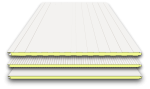
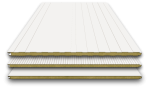
Instead of an uninsulated trapezoidal sheet metal garage, which later has to be insulated at great expense, sandwich panels for roofs and sandwich panels for walls offer a complete insulated solution right from the start. Sandwich panels combine external cladding, thermal insulation and internal panelling in one factory-produced construction element.
Advantages of integrated insulation
No condensation: The polyurethane (PU) or PIR insulation core prevents condensation. The inside remains dry - vehicles, tools and stored items are protected.
Optimum U-values: Sandwich panels achieve U-values of 0.19-0.44 W/m²K depending on the core thickness (40-200 mm). These values are guaranteed at the factory and already take into account all fixings.
No thermal bridges: The insulation core is fully foamed with the surface layers. The tongue and groove system prevents linear thermal bridges. In contrast to retrofit insulation, there are no continuous metal profiles.
No loss of space: the insulation is integrated into the wall thickness. No interior space is reduced by additional insulation levels.
Fast installation: sandwich panels are mounted directly onto the substructure - without separate insulation, vapour barrier or interior cladding. The construction time is significantly shorter than with subsequently insulated sheet metal garages.
Attractive appearance: The inside has a clean, coated surface in various RAL colours and finishes. The garage has a high-quality and inviting appearance.
Greater stability: Sandwich panels with a core thickness of 60-100 mm are significantly more stable than thin trapezoidal sheet metal. They offer better burglary protection.
Maintenance-free: The closed construction minimises maintenance requirements. No need to check vapour barriers.
Comparison: Trapezoidal sheet metal vs. sandwich panels for garages
|
Criterion |
Trapezoidal sheet metal (uninsulated) |
Trapezoidal sheet + post-insulation |
Sandwich panels |
|
Thermal insulation |
None |
U-value 0.25-0.40 W/m²K |
U-value up to 0.11 W/m²K |
|
Condensation protection |
No, drip formation |
Risk remains |
Yes, dry |
|
Thermal bridges |
Not relevant |
Unavoidable |
Minimised |
|
Loss of space |
None |
10-20 cm per side |
None |
|
Assembly time |
Quick |
Several days/weeks |
Quick |
|
Maintenance |
Low |
Check vapour barrier |
Maintenance-free |
|
Interior appearance |
Bare metal |
Cladding required |
Coated surface |
|
Comfort of use |
Very low |
Satisfactory |
High |
|
Economic efficiency |
Initially favourable |
Expensive subsequently |
Optimal in the long term |
Application recommendation: Sandwich panels are the better choice for new buildings and high-quality garages. The integration of insulation, vapour barrier and cladding eliminates the typical problems of uninsulated or subsequently insulated sheet metal garages. Further technical details can be found in our detailed guide to sandwich panels.
Conclusion: Choosing the right garage solution
A trapezoidal sheet metal garage is an economical solution for simple storage requirements without the need for comfort. Without insulation, however, it is only of limited use: condensation, temperature fluctuations and moisture make it a problem area.
Retrofitting insulation to a sheet metal garage is possible, but is time-consuming, expensive and involves compromises. Thermal bridges remain, loss of space is unavoidable and the risk of condensation cannot be completely eliminated.
Anyone building a garage today should opt for factory-insulated sandwich panels from the outset. They offer optimum U-values, prevent condensation, save construction time and offer greater user comfort in the long term. The additional costs compared to uninsulated trapezoidal sheeting are amortised by the savings on retrofitting and improved usability.
Our recommendation: Let us advise you individually on which garage solution is best for your requirements. We offer suitable systems ranging from simple storage garages to comfortable workshops. Successful reference projects demonstrate the versatility of modern garage designs.
Last updated Nov 2025
Location and yard in Europe

From 10 locations, we can deliver across Europe