

Trapezoidal sheet façade: design, care & modern alternatives
A trapezoidal sheet metal façade offers an economical and robust solution for the external cladding of industrial, commercial and residential buildings. The characteristic corrugated profile gives buildings a modern look while providing reliable protection against the weather. As metal cladding, trapezoidal sheeting is particularly suitable for large areas and impresses with its durability.
However, modern building requirements now place higher demands on thermal insulation and installation efficiency. While trapezoidal sheets have proven properties, façade panels are increasingly becoming a superior alternative for demanding projects.
What is a trapezoidal sheet façade?
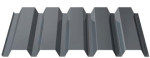
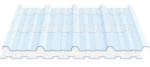
Trapezoidal sheet ing consists of cold-formed sheet steel with characteristic trapezoidal profiles. This façade cladding is attached horizontally or vertically to a substructure and forms the weatherproof outer skin of buildings.
The trapezoidal profiling gives the relatively thin sheet metal (usually 0.5-0.7 mm material thickness) the necessary rigidity for large spans. Depending on the profile height and spacing, trapezoidal sheets achieve different load-bearing capacities and are suitable for both small outbuildings and long-span hall construction projects.
The galvanised and coated surface protects the sheet steel against corrosion and enables a service life of several decades when used properly.
Design options with trapezoidal sheet on the façade
Profile shapes and looks
Trapezoidal sheets for façade cladding are available in various profile heights:
- Low profiles (15-35 mm): Discreet lines, less shadow effect
- Medium profiles (35-60 mm): Balanced ratio of appearance and load-bearing capacity
- High profiles (60-200 mm): Striking structure, maximum load-bearing capacity
The profiles can be laid either horizontally or vertically. Vertical installation emphasises the height of the building and is particularly suitable for prestigious buildings, while horizontal installation visually stretches buildings and is widely used in industrial buildings.
RAL colours and surface coatings
Modern trapezoidal sheets offer a wide range of RAL colours and surface textures:
Standard colours: RAL 9002 (grey white), RAL 7016 (anthracite grey), RAL 9006 (white aluminium)
Coating qualities:
- Polyester Standard: 25 µm layer thickness, economical solution
- Polyester HD: Higher durability, better UV protection
- PVDF coating: Premium quality with 35 µm layer thickness
The coating quality has a decisive influence on the durability and colour fastness of the façade. Higher-quality coatings are recommended for prestigious buildings and aggressive environments.
Technical aspects of trapezoidal sheet metal façade cladding
Fastening and substructure
Proper fastening is crucial for the durability of a trapezoidal sheet metal façade. The substructure typically consists of galvanised C or Z profiles, which are fastened to the supporting structure at intervals of 1.0-1.5 metres.
Fastening elements:
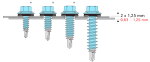
- Self-drilling trapezoidal sheet metal screws with EPDM gasket
- Spacing of the fixing points: every 3-5 profile waves
- Minimum screw-in depth: 20 mm in steel substructure
Correct preparation of the drill holes and the correct tightening force of the screws prevent leaks and premature wear.
Rear ventilation for trapezoidal sheet facades
Trapezoidal sheet rear ventilation is essential for insulated constructions. The rear ventilation gap of at least 20 mm between the insulation and the trapezoidal sheet enables
- Removal of moisture
- Temperature equalisation to prevent condensation
- Reduction of thermal bridges
Without sufficient rear ventilation, moisture damage can occur to the insulation and the supporting structure. Air circulation is ensured by perforated ventilation profiles at the eaves and ridge.
Maintenance and care of trapezoidal sheet metal façades
Trapezoidal sheet metal façades are considered low-maintenance, but require regular inspection for optimum durability:
Annual visual inspection:
- Checking the fastening elements for tightness
- Checking the seals on screw connections
- Inspection of the coating for damage
Cleaning:
- Remove dirt with clear water
- For stubborn deposits: neutral cleaning agents
- Avoid aggressive chemicals and high-pressure cleaning
Repairs:
- Touch up minor damage immediately with repair paint
- Replace defective seals promptly
- For major damage: Replace individual panels
The service life of a trapezoidal sheet metal façade is 25-40 years with professional installation and regular maintenance.
Corrosion protection for metal cladding
Corrosion protection is of crucial importance for any metal cladding. Modern trapezoidal sheets have multiple layers of protection:
Basic equipment:
- Hot-dip galvanising with 275 g/m² zinc coating in accordance with DIN EN 10346
- Conversion layer as adhesion promoter
- Primer and top coat
Special environments: In salty sea air or chemically contaminated industrial areas, reinforced coatings or stainless steel grades are required.
Detailed information on corrosion protection for metal cladding can be found in our separate guide article.
Costs of trapezoidal sheet metal façades
The costs of trapezoidal sheet metal cladding are made up of various components:
Material costs per m² (rough estimates):
- Trapezoidal sheet metal: €8-15 (depending on profile height and coating)
- Substructure: 12-18 €
- Insulation (if required): 8-25 €
- Fastening elements: 2-4 €
Installation costs: 15-25 € per m² depending on the complexity of the building (approximate values)
Total costs: 45-87 € per m² turnkey installed (rough estimate)
The cost-effective solution makes trapezoidal sheet metal particularly attractive for large areas and industrial buildings. For smaller properties or higher insulation requirements, however, the cost advantage is relativised.
All cost figures are rough guidelines and can vary greatly depending on the region, project size and specific requirements. For a precise calculation, we recommend an individual consultation.
Modern alternative: façade panels and sandwich panels
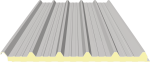
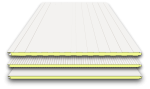
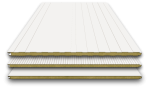
While trapezoidal sheets offer proven properties, façade panels are increasingly becoming the superior solution for modern building requirements. Sandwich panels for walls combine cladding, insulation and a vapour barrier in a single construction element.
Advantages of sandwich panels for façades
Integrated thermal insulation: sandwich panels achieve U-values of 0.19-0.44 W/m²K without an additional insulation layer. The insulating core made of polyurethane or PIR is permanently bonded to the outer layers and avoids thermal bridges.
Simplified installation: One work step replaces the separate installation of vapour barrier, insulation, substructure and cladding. This significantly reduces installation time and sources of error.
Improved airtightness: The tongue and groove system of the façade panels ensures precise joints without the need for time-consuming reworking. Complete systems with concealed fixings offer additional design benefits.
Maintenance-free: The completely sealed construction prevents the ingress of moisture and vermin. Ventilation problems are completely eliminated.
Comparison: Trapezoidal sheet metal vs. façade panels
|
Criterion |
Trapezoidal sheet metal |
Façade panels |
|---|---|---|
|
Installation time |
Several work steps |
One work step |
|
Thermal insulation |
Separate insulation layer required |
Integrated |
|
U-value |
0.8-1.2 W/m²K (with insulation) |
0.19-0.44 W/m²K |
|
Airtightness |
Elaborate detail work |
System-related tightness |
|
Maintenance |
Annual inspections |
Maintenance-free |
|
Fire protection |
standard |
Up to F120 with fire protection panels |
Application recommendation: For high-quality commercial buildings, residential buildings and properties with strict energy standards, sandwich panels offer clear advantages over traditional trapezoidal sheet metal constructions.
Conclusion: Choosing the right façade solution
Trapezoidal sheet metal façades remain an economical solution for simple industrial buildings and temporary constructions. The proven technology is particularly suitable for large surfaces and low insulation requirements.
However, façade panels are the contemporary alternative for modern construction projects with requirements for energy efficiency, speed of installation and durability. The higher material costs are amortised through reduced installation costs and better energy values.
Our recommendation: Let us advise you individually on the best solution for your project. From low-cost stock items to customised special solutions, we offer the right system for every requirement. Successful reference projects demonstrate the versatility of modern façade systems.
Various RAL colours enable individual design that meets both functional and aesthetic requirements.
Last updated Nov 2025
Location and yard in Europe
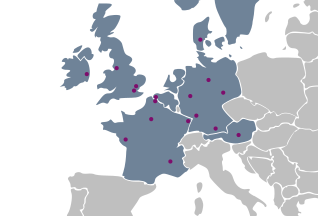
From 10 locations, we can deliver across Europe